
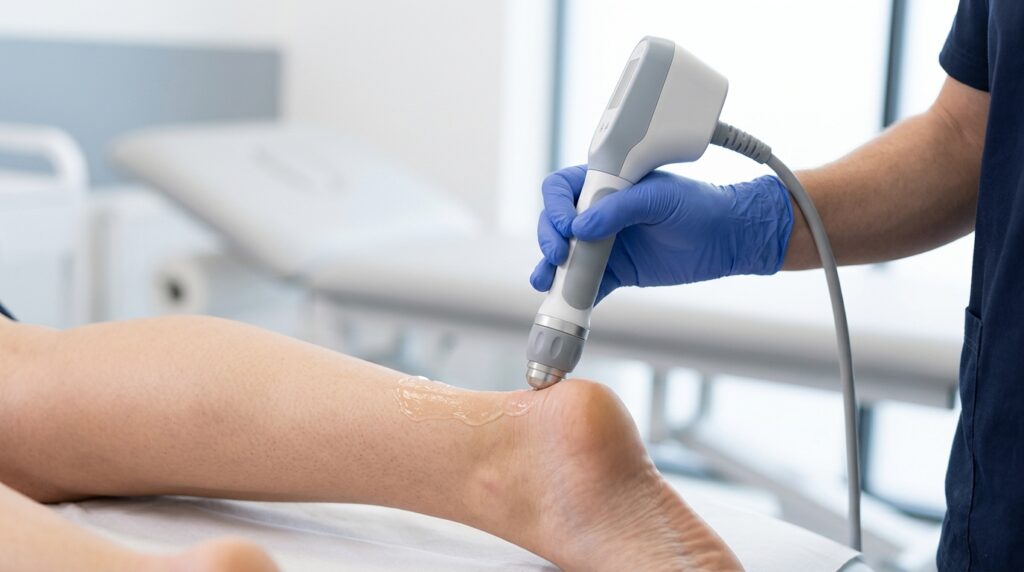
What is shockwave therapy? It is a non-invasive treatment that sends strong pulses of acoustic energy through the skin into a painful tendon or soft tissue, with the aim of reducing pain and restarting a healing process that has stalled. It is used mainly for stubborn tendon problems that have not settled with rest, exercise and other hands-on care. Many patients first find us by searching for a chiropractor near me, then discover that BackSpace, Clapham’s multi-award-winning chiropractic and sports massage clinic founded in 2016, also offers shockwave for long-standing tendon pain. This guide explains how it works, what the evidence says, who it suits and what a course of treatment involves.
Extracorporeal Shockwave Therapy Explained
The full clinical name is extracorporeal shockwave therapy, usually shortened to ESWT. “Extracorporeal” simply means the energy is generated outside the body. Nothing is injected and the skin is not broken.
A handheld applicator is placed against the skin over the painful area, with a layer of gel to transmit the energy. The device then delivers a rapid series of pulses. You hear a firm tapping sound and feel a strong, sometimes sharp, pressure in the tissue. Settings are adjusted to your tolerance throughout the session.
Radial and Focused Shockwave
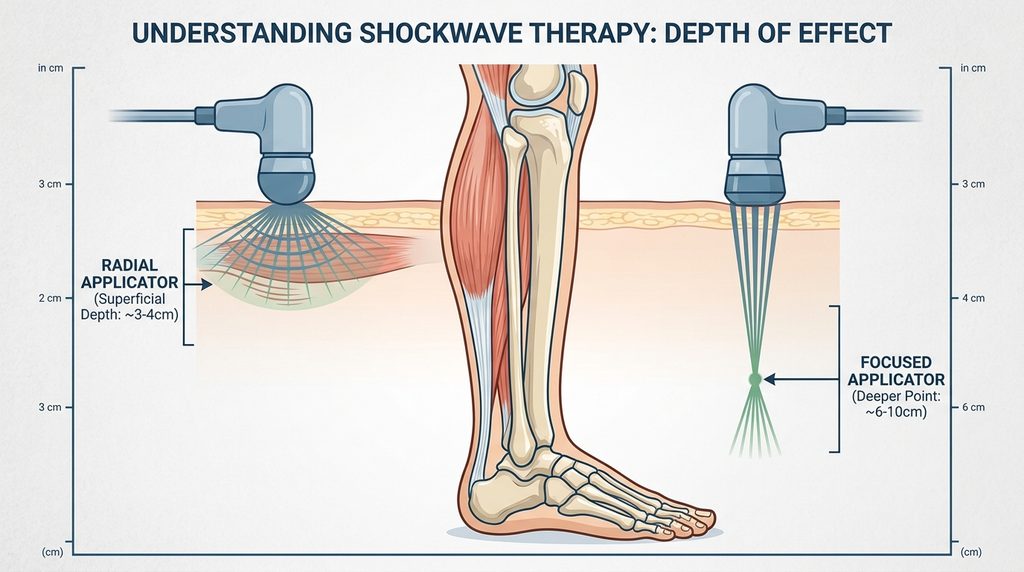
There are two main types of shockwave device, and they behave differently.
| Feature | Radial Shockwave | Focused Shockwave |
|---|---|---|
| How energy travels | Spreads outwards from the applicator | Concentrated on a target point at a set depth |
| Depth of effect | Mainly superficial tissues | Can reach deeper structures |
| Typical use | Tendons close to the surface, such as the Achilles, elbow and heel | Deeper tendons and targeted points |
| How it feels | Broad, strong tapping | More intense at a single point |
Both are used for tendon problems. What matters more than the device is that the right structure is identified first and that shockwave forms part of a wider plan.
How Shockwave Therapy Works
The exact mechanism is still being researched, and NICE notes that it is not fully understood. The most widely accepted explanations are:
- Restarting a stalled healing response: long-standing tendon problems often sit in a state where the tissue has stopped adapting. Shockwave creates a controlled mechanical stimulus that appears to encourage blood flow and cell activity in the area.
- Reducing pain signalling: the pulses seem to calm overactive pain nerves in the treated tissue, which is why some patients notice easing soon after a session.
- Breaking down calcification: in some shoulder tendon problems, calcium deposits form within the tendon. Shockwave may help to break these down.
This is why shockwave suits chronic problems rather than fresh injuries. It works best on tissue that has stopped healing, not tissue that is still in its early repair phase.
What Conditions Does Shockwave Therapy Treat?
Shockwave is mostly used for tendon and soft tissue problems that have lasted three months or more and have not responded to a structured exercise programme. The table below summarises the most common uses and the current state of the evidence.
| Condition | Where It Hurts | Evidence and Guidance |
|---|---|---|
| Plantar fasciitis | Underside of the heel | NICE found no major safety concerns; efficacy evidence is mixed |
| Achilles tendinopathy | Back of the heel and lower calf | NICE found no major safety concerns; efficacy evidence is limited and inconsistent |
| Tennis elbow | Outer elbow and forearm | NICE allows use with clear consent and audit |
| Lateral hip pain | Outer hip, worse lying on that side | Low-level evidence supports use in some cases |
| Patellar tendinopathy | Front of the knee, below the kneecap | Mixed evidence; best used alongside loading exercise |
| Shoulder tendon problems | Front or side of the shoulder | Most often used for calcific tendon problems |
Heel and Foot Pain
Heel pain that is worst with the first steps in the morning is one of the most common reasons people ask about shockwave. NICE guidance on shockwave for refractory plantar fasciitis found no major safety concerns but described the efficacy evidence as inconsistent. In practice, we use it for plantar fasciitis that has persisted despite calf and foot strengthening, footwear changes and load management.
Achilles Tendon Pain
NICE’s review of shockwave for Achilles tendinopathy reached a similar conclusion: no major safety concerns, with efficacy evidence that is limited and inconsistent. The research suggests shockwave performs comparably to progressive loading exercise for mid-portion Achilles pain, and may add benefit when combined with it.
Elbow and Shoulder Problems
For persistent outer elbow pain, shockwave can be a useful option when grip and forearm strengthening alone have not been enough. If you have been searching for tennis elbow treatment, it is worth knowing that most cases settle with time and exercise, and shockwave is usually reserved for the stubborn ones. In the shoulder, shockwave is mainly considered for calcific tendon problems and longer-standing rotator cuff injuries that have not responded to rehab.
Hip and Knee Tendon Pain
Outer hip pain from the gluteal tendons and pain below the kneecap from patellar tendinopathy are both common in runners and active people. A 2018 systematic review in the British Journal of Sports Medicine found low-level evidence that shockwave may be effective for several lower limb conditions, including these. We assess these alongside other causes as part of our hip and knee pain care.
Who Is Shockwave Therapy Not Suitable For?
Shockwave is generally safe, but it is not appropriate for everyone. We do not use it if you:
- Are pregnant or trying to conceive
- Are under 18, as growth plates may still be active
- Have had a steroid injection into the area within roughly the last 12 weeks
- Have a blood clotting disorder or take anticoagulant medication
- Have an infection, open wound or tumour in the treatment area
- Have a recent tendon tear or acute injury at the site
- Have reduced sensation over the area being treated
It is also not applied over the lungs or major blood vessels and nerves. Your full medical history is checked before any treatment.
What to Expect From a Course of Shockwave Therapy
Your Assessment
Shockwave is never the starting point. Your first appointment involves a detailed history and examination to confirm that the problem is a tendon or soft tissue issue that is likely to respond. If shockwave is not the right fit, we will tell you and discuss alternatives.
During a Session
Each treatment takes around 15 minutes. The intensity is built up gradually and kept within a level you can tolerate. Most people describe it as uncomfortable rather than painful, and the discomfort stops as soon as the device does.
How Many Sessions You Need
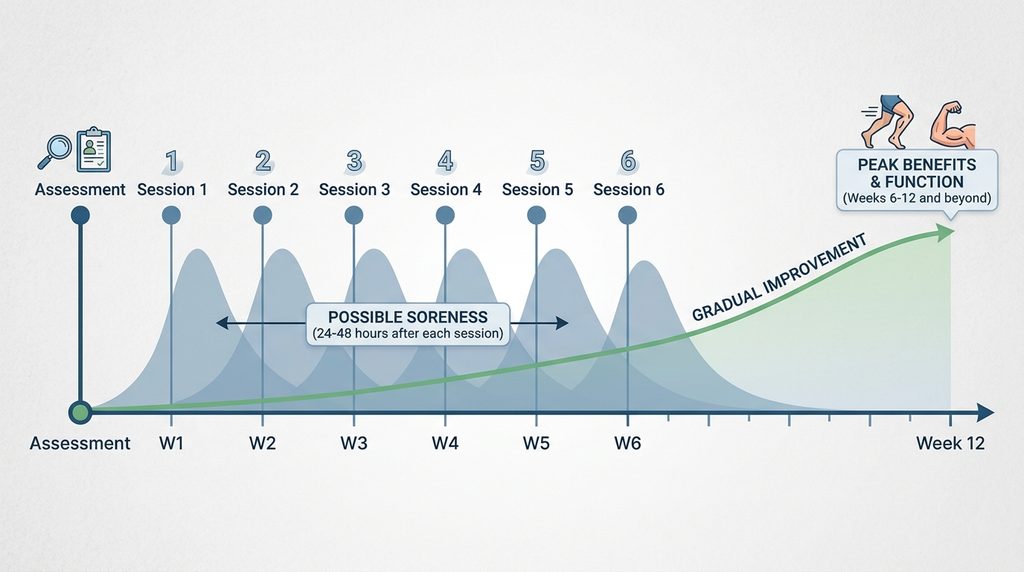
Most patients need between three and six sessions, usually spaced about a week apart. Pain relief can start within the first few sessions, but the full effect often builds over the following 6 to 12 weeks as the tissue adapts.
After Treatment
The treated area may feel sore, red or slightly swollen for a day or two. Occasionally there is mild bruising. We usually advise avoiding anti-inflammatory medication and ice on the area for a short period after treatment, as these may dampen the response shockwave is trying to create. Rarely, more serious damage such as a tendon tear has been reported, which is why careful assessment matters.
Shockwave Compared With Other Treatment Options
| Option | How It Works | Best Suited To | Considerations |
|---|---|---|---|
| Progressive loading exercise | Strengthens the tendon gradually over weeks | Almost all tendon problems, as the foundation of care | Needs consistency over 8 to 12 weeks or more |
| Shockwave therapy | Acoustic pulses to stimulate repair and reduce pain | Chronic tendon pain not settling with exercise alone | Usually 3 to 6 sessions; works best combined with exercise |
| Hands-on soft tissue work | Eases tension in surrounding muscles | Muscle tightness that is adding to tendon load | Supports recovery rather than treating the tendon directly |
| Steroid injection | Reduces pain and inflammation | Short-term relief in selected cases | Effects may wear off; may not suit tendons long term |
| Surgery | Repairs or releases the affected tissue | Severe cases where other options have failed | Longer recovery and higher risk |
Why Shockwave Works Best as Part of a Plan
Shockwave does not replace rehabilitation. Tendons get stronger through load, so treatment without exercise tends to give short-lived results. At BackSpace, shockwave is combined with tailored strengthening exercises, advice on training load and, where helpful, soft tissue work. For tight surrounding muscles, deep tissue massage in Clapham can be a useful addition. For active patients, this sits within our broader approach to sports injury treatment.
Shockwave Therapy in London at BackSpace
We offer shockwave therapy in London from our clinic in Clapham, delivered by our GCC-registered chiropractors as part of a full assessment and rehab plan. You can read about the clinicians who deliver it on our team page, and practical details on booking, clothing and insurance are covered in our clinic FAQs.
BackSpace is at 15 Clapham Park Road, London SW4 7EE, a one-minute walk from Clapham Common Underground station (use the Clapham Common South Side and Clapham Park Road exit). Call 020 7498 7998, email info@thebackspace.co.uk, or book an appointment online.
Frequently Asked Questions
-
Does Shockwave Therapy Hurt?
Most people find it uncomfortable rather than painful. You will feel strong tapping and pressure over the sore area, and the most tender spots can feel sharp for a few seconds. The intensity is built up gradually and adjusted to what you can tolerate, and you can ask for it to be turned down at any time. Discomfort stops when the device stops, although the area may feel sore or tender for a day or two afterwards.
-
How Many Shockwave Therapy Sessions Will I Need?
Most patients need between three and six sessions, spaced roughly a week apart. The exact number depends on the condition, how long you have had it and how you respond. We review your progress after the first few sessions. Some people notice relief early, while others see the main improvement in the weeks after the course has finished, as the tendon continues to adapt alongside your exercise programme.
-
How Quickly Does Shockwave Therapy Work?
Some patients notice reduced pain within the first two or three sessions. For many, though, the more lasting benefit builds gradually over 6 to 12 weeks after treatment starts, as the tendon responds and strengthens. That is why we combine shockwave with a progressive exercise plan and review progress regularly. If there is no meaningful change after a full course, we will reassess and discuss other options rather than continue indefinitely.
-
Is Shockwave Therapy Safe?
NICE has reviewed shockwave for several tendon conditions and found no major safety concerns. The most common side effects are temporary soreness, redness, swelling or bruising over the treated area, which usually settle within a few days. Serious complications such as tendon rupture are rare. Safety depends on a proper assessment, checking for reasons not to treat, such as pregnancy, recent steroid injections or clotting problems, and using settings appropriate to the tissue.
-
Can I Exercise After Shockwave Therapy?
Yes, in most cases. We usually advise avoiding high-impact or very heavy training on the treated area for 24 to 48 hours after each session, then continuing with your prescribed rehab exercises. Staying active is part of how the treatment works, as tendons respond to the right amount of load. Your clinician will give you specific guidance on running, gym work or sport based on your condition and how the area feels.
-
Where Can I Get Shockwave Therapy Near Me in London?
If you are looking for shockwave therapy near me in south or central London, BackSpace in Clapham offers it as part of a full assessment and rehab plan. The clinic is a one-minute walk from Clapham Common Underground station on the Northern line, so it is quick to reach from across south and central London. Treatment is delivered by our GCC-registered chiropractors, and every course starts with an assessment to confirm shockwave is right for you.
Shockwave therapy is not a quick fix, but for the right tendon at the right time, it can be the step that gets a stalled recovery moving again.