

What causes neuralgia comes down to a nerve that has been compressed, irritated, inflamed or damaged and starts firing pain signals it should not. The trigger might be a trapped nerve in your neck, a disc pressing on a nerve root in your lower back, a blood vessel resting against a nerve in the skull, or the after-effects of shingles. As GCC-registered chiropractors who have helped people searching for a chiropractor near me in Clapham since 2016, we see nerve pain every week, and the first step is always the same: find out which nerve is involved and why.
What Is Neuralgia?
Neuralgia simply means “nerve pain”. It describes pain that travels along the path of a specific nerve rather than sitting in one muscle or joint.
Nerve pain feels different from ordinary aches. Patients describe it as:
- Sharp, shooting or stabbing, often in brief bursts
- Electric-shock-like, sometimes set off by light touch
- Burning or tingling, with pins and needles or numbness
- Following a line, for example from the neck into the hand, or from the buttock down the leg
Neuralgia vs muscle pain
Muscle pain is usually a dull, broad ache that gets worse with use and eases with rest. Nerve pain is more precise, more electric and often travels well beyond the original problem area. That distinction matters, because it changes what treatment will help.
What Causes Neuralgia? The Main Triggers
There is no single cause. In practice, the causes fall into five groups.
1. Nerve Compression: The Trapped or Pinched Nerve
This is the cause we see most often. A pinched nerve happens when surrounding tissue, such as a bulging disc, an arthritic joint or tight muscle, puts pressure on a nerve or nerve root.
Common sites include:
- The neck (cervical radiculopathy): pain, tingling or weakness running into the shoulder, arm or hand
- The lower back (lumbar radiculopathy): pain travelling into the buttock and leg, commonly called sciatica
- The base of the skull: irritation of the occipital nerves, causing sharp pain at the back of the head
2. Viral Infection: Shingles and Postherpetic Neuralgia
Shingles is caused by the chickenpox virus reactivating along a nerve. For some people, pain continues long after the rash heals. This is called postherpetic neuralgia (PHN). UK government figures put the number at about 14,000 people developing PHN each year, with more than 1,400 admitted to hospital because of it, according to the shingles vaccination guidance from GOV.UK.
3. Blood Vessel Pressure on a Facial Nerve
Trigeminal neuralgia causes sudden, severe facial pain, usually on one side. The NHS explains that the classical form is usually caused by an artery or vein pressing on the trigeminal nerve near the brainstem. It tends to start between the ages of 50 and 60 and affects women more often than men.
4. Disease, Injury and Surgery
Conditions that damage the protective coating of nerves, such as multiple sclerosis, can cause neuralgia. So can direct trauma, scar tissue after surgery, and, rarely, a tumour pressing on a nerve.
5. Contributing Factors
Some factors make nerves more sensitive rather than causing neuralgia directly:
- Diabetes and poor blood sugar control
- Long periods of sitting or static posture
- Repetitive strain from work or sport
- Age-related changes in the spine
- High stress and poor sleep, which lower your pain threshold
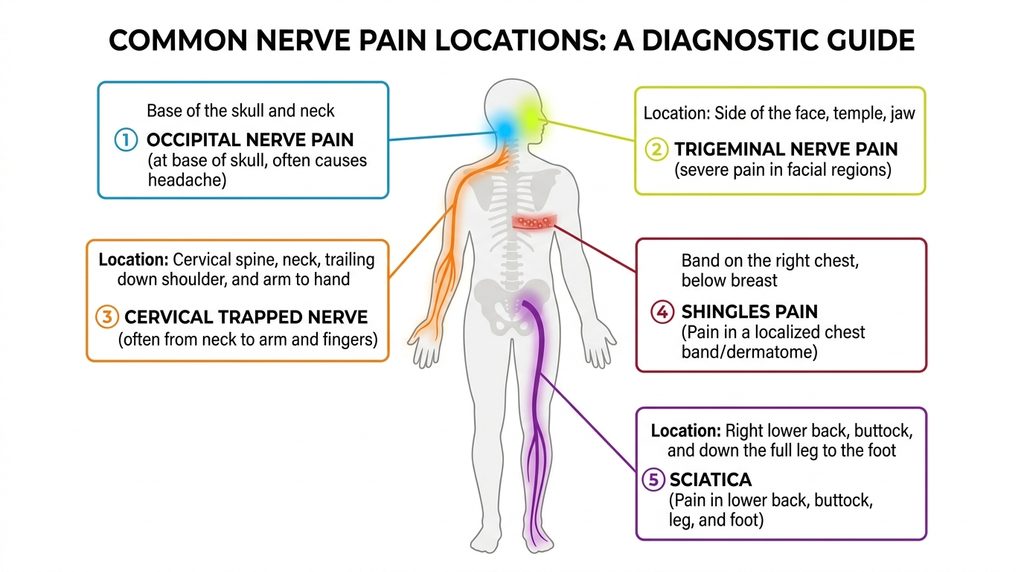
Types of Neuralgia at a Glance
| Type | Nerve Involved | Typical Cause | Where You Feel It | Who Should Lead Care |
|---|---|---|---|---|
| Cervical radiculopathy | Nerve roots in the neck | Disc bulge, joint arthritis, muscle tension | Neck, shoulder, arm, hand | Chiropractor, with GP if severe |
| Sciatica | Sciatic nerve roots | Disc bulge, narrowing in the lower spine | Buttock, back of leg, foot | Chiropractor, with GP if severe |
| Occipital neuralgia | Occipital nerves | Neck joint or muscle irritation | Back of head, scalp | Shared care: GP and chiropractor |
| Trigeminal neuralgia | Trigeminal nerve | Blood vessel compression, MS | One side of the face | GP and neurology |
| Postherpetic neuralgia | Nerve affected by shingles | Shingles virus | Band of skin where the rash was | GP |
Trapped Nerve Pain: Symptoms to Recognise
Trapped nerve pain has a recognisable pattern. You may notice:
- Pain that radiates away from the spine into a limb
- Pins and needles, numbness or a “dead” feeling in a hand or foot
- Weakness, such as dropping objects or a foot that catches when you walk
- Symptoms that change with position, like worse when sitting or looking down at a phone
- Pain that flares with coughing or sneezing
Trapped Nerve in the Neck
A trapped nerve in the neck often starts as stiffness and neck pain, then spreads into the shoulder blade and arm. Desk workers who spend long hours with their head forward are a common group.
Trapped Nerve in the Lower Back
In the lower back, nerve irritation usually sits alongside lower back pain, with leg symptoms that can feel worse than the back itself. Prolonged sitting and driving are frequent aggravators, which is why our tips to avoid back pain when driving are worth reading if you commute by car.
Red Flags: When Nerve Pain Needs Urgent Care
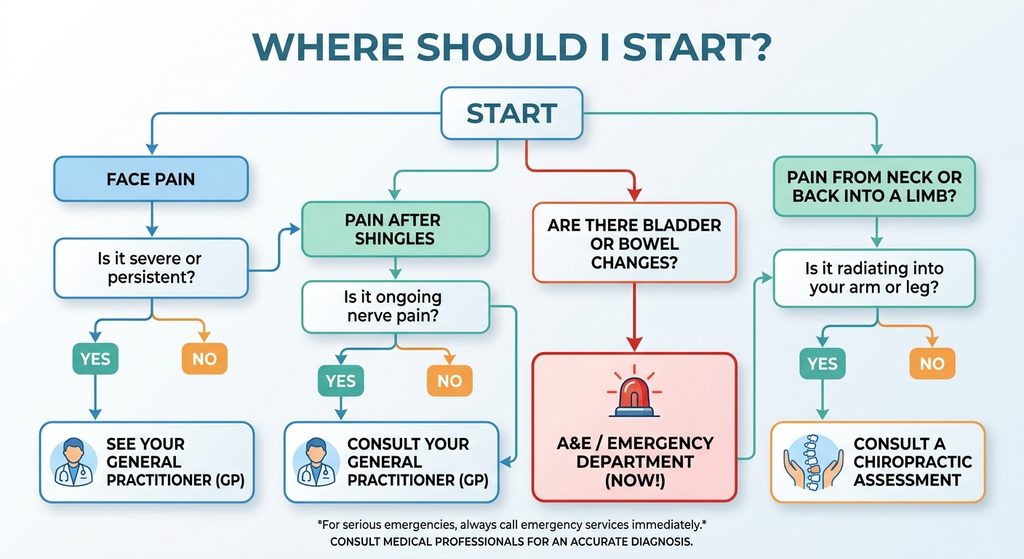
Most nerve pain is not dangerous. However, some symptoms need same-day medical attention. Go to A&E or call 999 if you have back pain or sciatica with:
- Numbness around the genitals, buttocks or inner thighs
- New difficulty passing urine, or loss of bladder or bowel control
- Weakness or numbness in both legs
These can be signs of cauda equina syndrome, a medical emergency.
See your GP promptly if nerve pain comes with unexplained weight loss, fever, a history of cancer, or severe facial pain.
How Neuralgia Is Diagnosed
There is rarely a single test. Diagnosis is built from:
- A detailed history: where the pain travels, what sets it off and what eases it
- Neurological testing: reflexes, muscle strength and skin sensation
- Nerve tension tests: such as a straight leg raise for sciatica
- Imaging when needed: MRI is used when results are likely to change treatment, not as routine
At BackSpace, every new patient has a full assessment before any treatment. If we find signs that point away from a mechanical cause, we refer you to your GP.
Trapped Nerve Treatment: What Actually Helps
The right treatment depends entirely on the cause. Being honest about that is part of good care.
Medical Care for Trigeminal and Postherpetic Neuralgia
Trigeminal neuralgia and PHN are managed medically, usually with specific nerve pain medicines prescribed by a GP or specialist. Manual therapy does not treat these conditions, so we would always direct you to the right clinician.
Chiropractic Care for Mechanical Nerve Irritation
When a nerve is irritated by stiff joints, a disc or tight tissue, chiropractic care can reduce the pressure and calm the nerve down. Our approach to trapped nerve treatment combines:
- Joint adjusting of the spine and limbs to restore movement
- Soft tissue work to ease protective muscle spasm
- Dry needling to reduce muscle tension around the irritated area
- Muscle taping to support posture and movement between visits
This matches NICE guidance on low back pain and sciatica, which recommends considering manual therapy only as part of a treatment package that includes exercise.
Sports and Deep Tissue Massage
Muscles around an irritated nerve often tighten up to guard it, which adds to the compression. Sports and deep tissue massage can release that guarding, particularly in the neck, shoulders and the deep hip muscles linked to sciatica.
Rehab Exercises and the McKenzie Method
Exercise is what keeps results. We use the McKenzie method to identify movements that centralise pain, meaning they draw symptoms back out of the limb and towards the spine. Patients then follow a home programme through our free app.
Where Shockwave Therapy Fits
Shockwave therapy works on tendons and soft tissue, not nerves. We only add it when a tendon problem, such as tennis elbow, sits alongside nerve symptoms.
| Approach | Best Suited To | Not Suited To |
|---|---|---|
| Chiropractic adjusting and soft tissue work | Trapped nerve in the neck or lower back, sciatica | Trigeminal neuralgia, PHN |
| Sports and deep tissue massage | Muscle guarding around an irritated nerve | Acute severe nerve inflammation |
| McKenzie method and rehab | Disc-related nerve root irritation | Red flag symptoms |
| Shockwave therapy | Tendon problems alongside nerve pain | Nerve pain on its own |
| GP or specialist care | Trigeminal neuralgia, PHN, red flags | Uncomplicated mechanical pain alone |
Case Study: Arm Pain From a Trapped Nerve in the Neck
This example is a composite of common presentations we treat. Details are illustrative and do not describe a single patient.
The presentation: A software developer in their late thirties arrives with three weeks of neck stiffness and sharp pain into the right forearm, with tingling in the thumb and index finger. Symptoms are worse after long video calls.
The assessment: Reduced neck rotation, positive nerve tension testing on the right, normal strength and reflexes, and no red flags.
The plan:
- Weeks 1 to 2: joint adjusting of the neck and upper back, soft tissue work and dry needling to the upper shoulder
- Weeks 2 to 4: McKenzie-based neck exercises and a revised desk set-up
- Weeks 4 to 6: strengthening and fewer visits as symptoms settle
The outcome: Arm pain eases first and the tingling settles over the following weeks, a typical pattern as nerve irritation calms.
Can You Prevent Neuralgia?
Not every type can be prevented, but you can lower your risk:
- Get vaccinated against shingles when eligible. The NHS offers Shingrix to people aged 65 and 70 to 79, to severely immunosuppressed adults from 18, and the programme is extending to everyone aged 60 and over by 2028.
- Break up long sitting periods every 30 to 45 minutes
- Set up your workstation with your screen at eye level
- Keep active, as regular movement keeps nerves gliding freely
- Manage blood sugar if you have diabetes
- Treat early, because a trapped nerve is easier to settle in weeks than months
Getting Help for Nerve Pain in Clapham
BackSpace is a multi-award-winning chiropractic and sports massage clinic at 15 Clapham Park Road, London SW4 7EE, a one-minute walk from Clapham Common Underground station (Northern line). You can meet our GCC-registered chiropractors before you visit, read our answers to common patient questions, call 020 7498 7998, or book an assessment online.
Frequently Asked Questions
-
What is the most common cause of neuralgia?
Nerve compression is the most common cause we see in clinic. A disc bulge, arthritic joint or tight muscle presses on a nerve root in the neck or lower back, producing pain that travels into the arm or leg. Shingles and blood vessel pressure on the trigeminal nerve are other well-known causes, but these are less common and are managed medically rather than with manual therapy. A full assessment identifies which cause applies to you.
-
How long does trapped nerve pain last?
Most cases of trapped nerve pain improve within six to twelve weeks, especially when treated early with a mix of manual therapy and exercise. Symptoms like pins and needles often take longer to settle than the pain itself, because nerves recover slowly. If pain is getting worse, spreading, or causing weakness, do not wait it out. Get assessed so the cause can be addressed before it becomes a long-term problem.
-
Can a chiropractor help with a pinched nerve?
Yes, when the pinched nerve has a mechanical cause such as a stiff joint, disc irritation or muscle tension. Chiropractic care uses joint adjusting, soft tissue work and targeted exercise to reduce pressure on the nerve and restore normal movement. It is not suitable for trigeminal neuralgia or nerve pain after shingles, which need medical treatment. Your chiropractor should always assess you first and refer you on if needed.
-
Where can I find trapped nerve treatment near me in Clapham?
BackSpace offers trapped nerve treatment near Clapham Common, at 15 Clapham Park Road, SW4 7EE. The clinic is a one-minute walk from Clapham Common Underground station on the Northern line, making it easy to reach from Clapham, Brixton, Balham, Stockwell and Battersea. Each visit starts with a full assessment by a GCC-registered chiropractor, followed by a treatment plan combining hands-on care and home exercises.
-
Is neuralgia serious?
Most neuralgia is not dangerous, but it can be very disruptive to sleep, work and exercise. Some symptoms do need urgent care: numbness around the groin or buttocks, new bladder or bowel problems, or weakness in both legs alongside back pain should be treated as an emergency. Severe facial pain, or nerve pain with fever or unexplained weight loss, should be checked by your GP promptly.
Nerve pain is your body’s signal that something needs attention, and the sooner the cause is found, the sooner it can settle.