
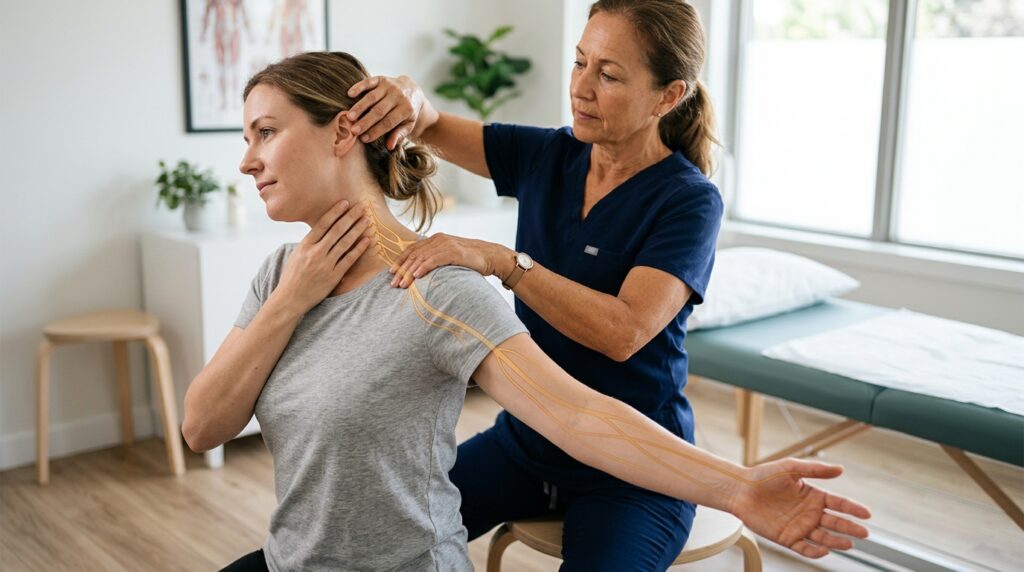
A trapped nerve in neck pain usually starts with stiffness on one side, then sends sharp pain, pins and needles or numbness down into the shoulder, arm or hand. It happens when a nerve root leaving the cervical spine is squeezed or inflamed by a disc, a worn joint or tight surrounding tissue. The good news is that most cases settle with the right care. As GCC-registered chiropractors helping people who search for a chiropractor near me in Clapham since 2016, we assess and treat this problem every week, and this guide explains what is going on, what to look out for and what actually helps.
What Is a Trapped Nerve?
What is a trapped nerve? It is the everyday term for a nerve that is being compressed or irritated by the structures around it. Clinicians call a trapped nerve in the neck cervical radiculopathy.
Your neck has seven vertebrae. Between them, pairs of nerve roots exit through small openings called foramina and travel down to supply your shoulders, arms and hands. If one of those openings narrows, or a disc bulges into it, the nerve root becomes irritated. The result is pain that follows the path of that nerve.
How common is it?
A widely cited review in the American Family Physician journal puts the annual incidence at about 83 cases per 100,000 people, with men affected slightly more often than women. It becomes more common from middle age onwards, when age-related disc and joint changes build up.
Neck pain vs a trapped nerve
Ordinary neck pain stays in the neck and upper shoulders and feels achy or stiff. A trapped nerve adds symptoms further down the arm, often with tingling, numbness or weakness. That difference changes how we assess and treat it.
Trapped Nerve Symptoms
Trapped nerve symptoms in the neck usually affect one side. Common signs include:
- Sharp, burning or electric pain spreading from the neck into the shoulder blade, arm or hand
- Pins and needles or numbness in specific fingers
- Weakness, such as dropping a cup or struggling to grip
- Pain that worsens when you look up, turn your head towards the painful side or sit for long periods
- Relief when you rest your hand on top of your head, a classic sign called the shoulder abduction relief sign
- Headaches at the base of the skull when the upper neck is involved
Which Nerve Is Trapped? A Symptom Map
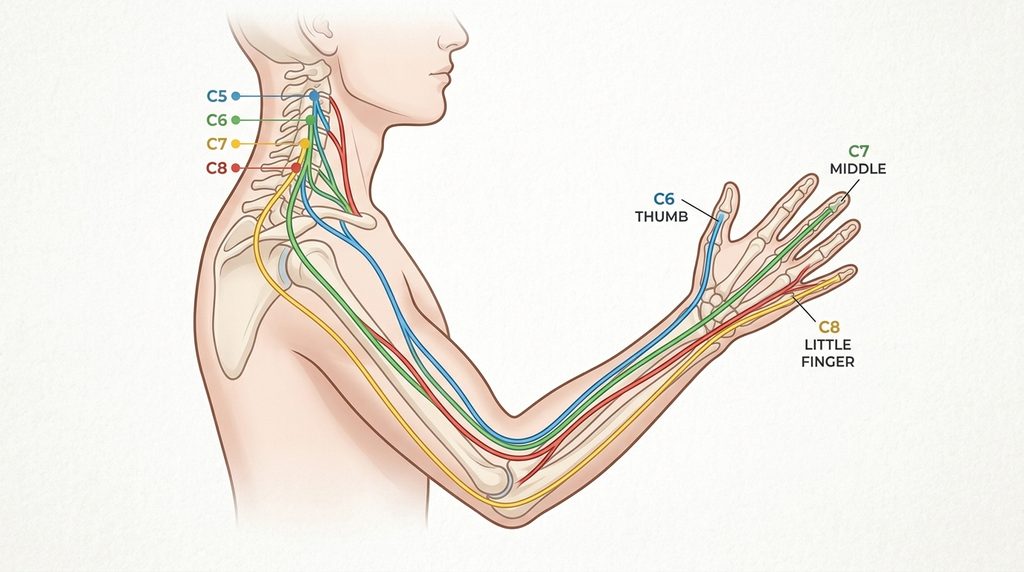
The pattern of your symptoms tells us which nerve root is likely involved. This is one of the first things we map during an assessment.
| Nerve Root | Where Symptoms Travel | Fingers Affected | Possible Weakness |
|---|---|---|---|
| C5 | Shoulder and outer upper arm | None | Lifting the arm out to the side |
| C6 | Outer forearm | Thumb and index finger | Bending the elbow, lifting the wrist |
| C7 | Back of the arm and forearm | Middle finger | Straightening the elbow, pushing |
| C8 | Inner forearm | Ring and little finger | Grip and fine finger movements |
Conditions That Can Mimic a Trapped Nerve
Not all arm pain comes from the neck. Shoulder tendon problems, tennis elbow and carpal tunnel syndrome at the wrist can all produce similar symptoms. A thorough examination separates these, because the treatment is different for each.
What Causes a Trapped Nerve in the Neck?
Several factors can narrow the space around a nerve root:
- Wear and tear (cervical spondylosis): bony changes and thickened joints gradually narrow the exit openings
- Disc bulge or herniation: the soft centre of a disc pushes out and presses on the nerve root, more common in younger adults
- Sudden strain or injury: whiplash, a fall, or lifting something heavy overhead
- Sustained posture: long hours with the head forward over a laptop or phone increase load on the lower neck
- Muscle tension: tight muscles around the neck and shoulder add pressure and keep the nerve sensitised
- Stress and poor sleep: these raise muscle tension and lower your pain threshold, much like we describe in our article on how stress affects back pain
The same review found that wear-related changes and disc problems together account for roughly 70% of cases. Interestingly, only around 15% of patients recalled a specific injury or strain beforehand. Many people simply wake up with it.
Red Flags: When to Get Urgent Help
Most trapped nerves are not dangerous. Seek same-day medical care, or call 999, if you notice:
- Clumsy hands, difficulty with buttons or writing, or problems with balance
- Symptoms in both arms, or in your legs
- Changes in bladder or bowel control
- Sudden, severe neck pain with a headache unlike any you have had before
- Neck pain after a significant fall or car accident
- Fever, unexplained weight loss or a history of cancer alongside neck pain
These signs can point to spinal cord compression or another serious cause. If you are unsure whether your symptoms fit, the NHS neck pain guidance is a useful starting point, and you should speak to your GP.
How We Assess a Trapped Nerve in the Neck
Every new patient at BackSpace has a full assessment before any hands-on care. This includes:
- A detailed history: where the pain goes, how it started and what changes it
- Neurological testing: muscle strength, reflexes and skin sensation in each arm
- Nerve provocation tests: gentle movements that load or unload the nerve to reproduce or ease symptoms
- Movement assessment: neck, upper back and shoulder mobility
- Screening: checks for red flags and for factors that make certain techniques unsuitable
Imaging is not needed for most people. An MRI is useful when there is progressive weakness, red flags, or no improvement despite good care, and we refer you to your GP when that is the case.
Treatment for Trapped Nerve in the Neck
Our treatment for trapped nerve problems in the neck aims to take pressure off the nerve, calm the irritation and restore normal movement. Hands-on care works best alongside exercise, so every plan combines both.
Chiropractic Care
Our trapped nerve treatment uses a mix of techniques chosen after your assessment:
- Joint adjusting of the upper back and neck to restore movement to stiff segments. When the nerve is very irritable, we use gentler mobilisation instead.
- Soft tissue work on the muscles around the neck and shoulder blade
- Dry needling to release tight, protective muscles
- Muscle taping to support posture between visits
Sports and Deep Tissue Massage
The muscles at the side and back of the neck often tighten to protect an irritated nerve. Deep tissue massage can ease that guarding, improve comfort and make exercises easier to perform.
McKenzie Method and Rehab Exercises
The McKenzie method helps us find specific neck movements that “centralise” symptoms, meaning they draw pain back out of the arm towards the neck. That is a positive sign. We then build a home programme to strengthen the deep neck and upper back muscles, delivered through our free app.
Where Shockwave Therapy Fits
Shockwave therapy treats tendons, not nerves. We only use it when a separate tendon problem, such as in the shoulder or elbow, sits alongside your neck symptoms.
| Approach | What It Targets | Best Stage |
|---|---|---|
| Joint adjusting and mobilisation | Stiff neck and upper back segments | Once the nerve is less irritable |
| Soft tissue work and massage | Protective muscle tension | All stages |
| Dry needling and taping | Muscle tightness, posture support | Early and middle stages |
| McKenzie method | Centralising arm symptoms | Early stage onwards |
| Strengthening exercises | Long-term control and prevention | Middle and late stages |
| Shockwave therapy | Coexisting tendon problems only | When indicated |
Trapped Nerve Pain Relief at Home
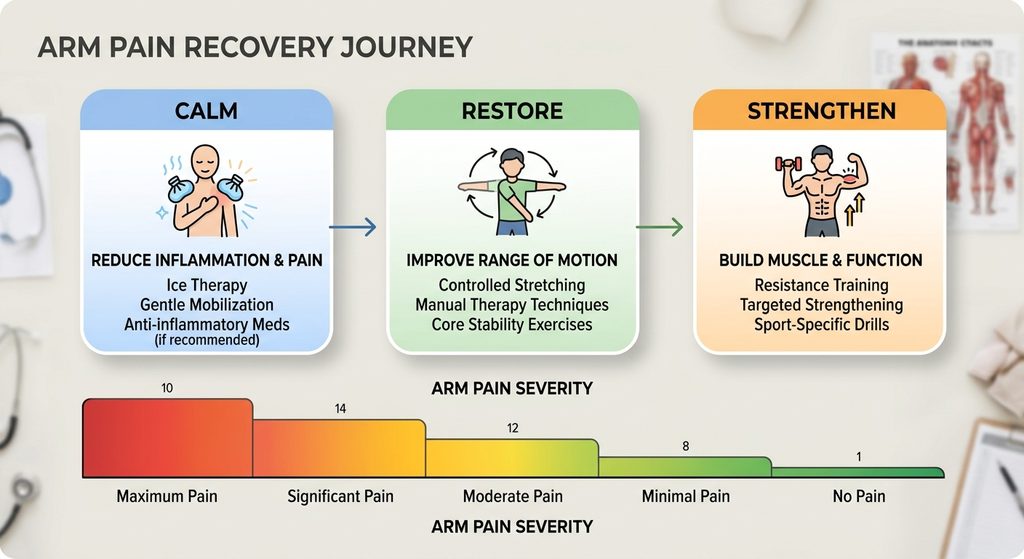
Alongside treatment, these steps offer practical trapped nerve pain relief:
- Keep moving gently. Avoid a neck collar unless a doctor advises it.
- Use heat on tight neck and shoulder muscles for 15 to 20 minutes.
- Try a lower, firmer pillow so your neck stays level while you sleep.
- Find your relief position. Resting your hand on your head can ease arm pain.
- Break up screen time every 30 to 45 minutes.
- Speak to a pharmacist or GP about suitable pain relief.
How Long Does a Trapped Nerve in the Neck Take to Heal?
Most people improve. A 2018 cohort study in the European Spine Journal followed patients managed without surgery and found that most of the improvement happened within the first six months. Longer symptom duration and higher starting pain were linked to slower recovery, which is a strong reason not to wait months before getting help.
Case Study: A Commuter Cyclist With Arm Pain
This example is a composite of common presentations we treat. Details are illustrative and do not describe a single patient.
The presentation: A 45-year-old who cycles to work develops right-sided neck pain after a weekend of DIY, followed by pain into the back of the arm and tingling in the middle finger. Triceps strength is slightly reduced.
The assessment: A C7 pattern, with symptoms reproduced by turning and tilting the head to the right. No red flags.
The plan:
- Weeks 1 to 2: gentle mobilisation, soft tissue work and dry needling; temporary changes to handlebar height
- Weeks 2 to 5: McKenzie-based neck exercises and upper back adjusting as symptoms ease
- Weeks 5 to 8: strengthening for the deep neck and shoulder blade muscles, with visits spaced out
The outcome: Arm pain eases first and moves back towards the neck. Tingling and triceps strength recover more gradually, which is the usual pattern as a nerve settles.
Preventing a Trapped Nerve in the Neck
- Raise your screen so the top sits at eye level
- Hold your phone higher rather than looking down
- Keep your upper back mobile with daily extension stretches
- Strengthen your deep neck flexors and shoulder blade muscles
- Warm up before overhead lifting in the gym
- Act early when neck stiffness starts spreading into your arm
Getting Help in Clapham
BackSpace is a multi-award-winning chiropractic and sports massage clinic at 15 Clapham Park Road, London SW4 7EE, a one-minute walk from Clapham Common Underground station (Northern line). You can meet our GCC-registered chiropractors, all registered with the General Chiropractic Council, read our patient FAQs, call 020 7498 7998 or book an appointment online.
Frequently Asked Questions
-
What does a trapped nerve in the neck feel like?
A trapped nerve in the neck usually feels like a sharp, burning or electric pain that spreads from one side of the neck into the shoulder blade, arm or hand. Many people also notice pins and needles or numbness in particular fingers, and some feel weakness when gripping. Symptoms often worsen when you look up or turn your head towards the painful side, and may ease when you rest your hand on top of your head.
-
Can a trapped nerve in the neck heal on its own?
Many cases do improve on their own over weeks to months as the inflammation around the nerve settles. However, recovery tends to be slower when symptoms have lasted a long time or pain is severe from the start. Treatment that combines hands-on care with targeted exercise can ease pain sooner and reduce the risk of recurrence. Any worsening weakness, symptoms in both arms or problems with balance should be checked promptly.
-
Is it safe to see a chiropractor for a trapped nerve?
Yes, when care starts with a thorough assessment. Before treating, a chiropractor screens for red flags and checks whether techniques like neck adjusting suit your situation. If the nerve is very irritable, gentle mobilisation, soft tissue work and exercises are used instead. All chiropractors in the UK must be registered with the General Chiropractic Council, and anyone with signs of a more serious problem is referred to their GP.
-
Where can I get trapped nerve treatment near me in Clapham?
BackSpace provides trapped nerve treatment near Clapham Common, at 15 Clapham Park Road, London SW4 7EE. The clinic is a one-minute walk from Clapham Common Underground station on the Northern line, which makes it easy to reach from Brixton, Balham, Stockwell and Battersea. Every first visit includes a full assessment by a GCC-registered chiropractor, followed by a clear plan combining hands-on treatment and home exercises.
-
Should I rest or keep moving with a trapped nerve?
Keep moving within comfortable limits. Complete rest and neck collars tend to increase stiffness and slow recovery. Gentle movement, short walks and regular breaks from sitting help keep the nerve and surrounding tissues mobile. Avoid positions that send pain further down your arm, such as looking up for long periods. If a movement draws your pain back towards your neck, that is usually a good sign that it is helping.
Arm pain that starts in the neck is common and usually very treatable, and the earlier it is assessed, the faster it tends to settle.