
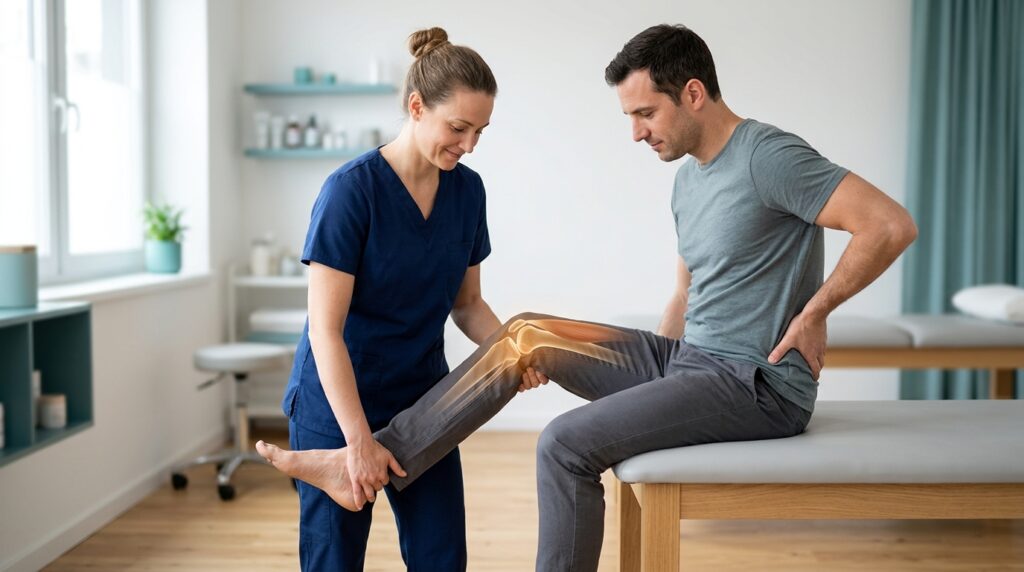
Musculoskeletal pain is any pain that affects the muscles, joints, bones, tendons, ligaments or the nerves that supply them. It covers everything from a stiff neck after a long day at the desk to a sore knee on the stairs, a strained calf or a lower back that locks up when you bend. It is the most common type of pain we see, and in most cases it responds well to the right mix of hands-on care and exercise. As the clinic many people find when searching for a joint stiffness chiropractor near me in Clapham, BackSpace has treated musculoskeletal problems since 2016, and this guide explains the types, the causes, the warning signs and what actually helps.
What Does Musculoskeletal Mean?
“Musculoskeletal” combines two words: muscle and skeleton. Your musculoskeletal system is the framework that holds you up and lets you move. It includes:
- Bones, which provide structure and protect organs
- Joints, where bones meet and allow movement
- Muscles, which pull on bones to create movement
- Tendons, which attach muscles to bones
- Ligaments, which connect bones and stabilise joints
- Cartilage and discs, which cushion joints and the spine
How Common Is Musculoskeletal Pain?
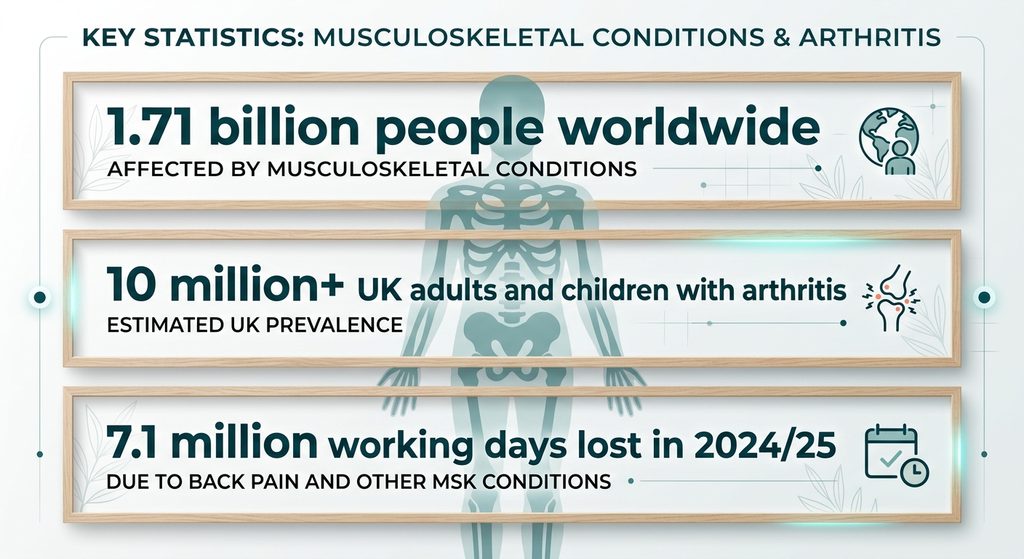
Very common. The World Health Organization estimates that around 1.71 billion people worldwide live with a musculoskeletal condition, making these conditions the leading contributor to disability globally. Low back pain alone is the top cause of disability in 160 countries.
In the UK, Arthritis UK’s State of Musculoskeletal Health 2026 report notes that more than 10 million people live with arthritis. At work, the Health and Safety Executive reports that work-related musculoskeletal disorders affected 511,000 workers in Great Britain in 2024/25, with 7.1 million working days lost.
Types of Musculoskeletal Pain
Muscle Pain (Myalgia)
Muscle pain usually feels like a broad ache, tightness or cramping. It often follows overuse, a sudden strain or long periods in one position. Trigger points, the tender knots people notice in their shoulders or back, are a common feature.
Joint Pain (Arthralgia)
Arthralgia simply means joint pain. It can feel like aching, stiffness or a deep soreness that worsens with movement or after rest. Arthralgia is a symptom, not a diagnosis, so finding the cause is the first step in any arthralgia treatment.
Bone Pain
Bone pain is usually deep, constant and sharply localised. It can follow a fracture or stress fracture, and in rare cases signals a more serious problem. Bone pain that is present at rest or at night always needs medical assessment.
Tendon and Ligament Pain
Tendon pain tends to be stiff at the start of activity, eases as you warm up, then returns afterwards. Ligament pain usually follows a twist or sprain and may come with a sense of the joint giving way.
Nerve-Related Pain
When a nerve is irritated by surrounding musculoskeletal structures, such as a disc in the lower back, it causes sharp, shooting or burning pain with pins and needles. Sciatica is the best-known example.
| Type | How It Usually Feels | Typical Triggers | Usually Worse With |
|---|---|---|---|
| Muscle | Broad ache, tightness, cramp | Overuse, posture, strain | Sustained use, stretching |
| Joint | Aching, stiffness, deep soreness | Wear, injury, inflammation | Movement or after rest |
| Bone | Deep, constant, localised | Fracture, stress fracture | Weight-bearing, at night |
| Tendon | Stiff, then warms up, then flares | Overload, sudden training increase | Start of activity, after rest |
| Nerve | Sharp, shooting, burning, tingling | Disc or joint pressure | Certain positions, coughing |
Common Causes of Musculoskeletal Pain
- Overuse and repetitive strain: typing, lifting, running or any repeated movement without enough recovery
- Sustained posture: long hours at a desk or looking down at a phone
- Injury: falls, sprains, strains and sports collisions
- Age-related changes: gradual changes in joints and discs, such as osteoarthritis
- Inflammation: inflammatory conditions such as rheumatoid arthritis and gout
- Deconditioning: weaker muscles provide less support to joints
- Stress and poor sleep: both increase muscle tension and lower your pain threshold
Many people have a mix of factors, which is why widespread, generalised aches and pains often need a broader plan than treating one sore spot.
Where Musculoskeletal Pain Shows Up
The most common areas we treat include:
- Back: acute and chronic back pain, often linked to sitting, lifting or stiffness
- Neck: neck pain and tension, frequently from screen posture
- Shoulders: shoulder complaints such as stiffness and pain lifting the arm
- Hips and knees: hip and knee pain on stairs, walking or squatting
- Elbows: tennis elbow from gripping and repetitive wrist use
- Sport-related: sports injuries to muscles, tendons and ligaments
Acute vs Chronic Musculoskeletal Pain
| Acute | Chronic | |
|---|---|---|
| Duration | Less than 6 weeks | More than 12 weeks |
| Typical cause | Clear injury or flare-up | Ongoing load, wear or a sensitised nervous system |
| Main goal | Calm pain, protect, restore movement | Rebuild strength, confidence and capacity |
| Best approach | Hands-on care plus gentle movement | Progressive exercise supported by hands-on care |
Pain that lasts longer is not necessarily more damaged. Over time, the nervous system can become more sensitive, so the same activity produces more pain. Treatment then focuses as much on building capacity as on the original tissue.
Arthralgia vs Arthritis: What’s the Difference?
People often use these words interchangeably, but they mean different things. Arthralgia is joint pain of any cause. Arthritis means there is inflammation or structural change in the joint.
| Feature | Mechanical Joint Pain (e.g. osteoarthritis) | Inflammatory Arthritis (e.g. rheumatoid) |
|---|---|---|
| Morning stiffness | 30 minutes or less | Often longer than 30 minutes |
| Pain pattern | Worse with activity, eases with rest | Can be worse at rest, eases with movement |
| Swelling | Occasional, usually mild | Warm, swollen, puffy joints |
| Joints affected | Often knees, hips, hands, spine | Often small joints of hands and feet, both sides |
| Who leads care | Chiropractor, exercise-based care | GP and rheumatology |
NICE guidance on osteoarthritis supports diagnosing osteoarthritis clinically in people aged 45 or over with activity-related joint pain and short morning stiffness, without the need for routine imaging. Long morning stiffness, hot swollen joints or symptoms in many joints at once need a GP review.
Warning Signs That Need a Doctor
Most musculoskeletal pain is not serious. See your GP promptly, or seek urgent care, if you have:
- A hot, red, swollen joint, particularly with fever
- Unexplained weight loss, night sweats or a history of cancer
- Bone pain that is constant, present at rest or wakes you at night
- Several swollen joints, or morning stiffness lasting longer than an hour
- Pain after a significant fall or accident
- Numbness around the genitals or bottom, loss of bladder or bowel control, or weakness in both legs (call 999)
At BackSpace, every new patient is screened for these signs, and we refer to your GP whenever a non-mechanical cause is suspected.
Joint Pain Treatment in London: How BackSpace Helps
Our approach to joint pain treatment in London combines a clear diagnosis, hands-on care and a progressive exercise plan. In line with NICE guidance, manual therapy is used alongside exercise rather than on its own.
Chiropractic Care
- Joint adjusting of the spine and limbs to restore movement to stiff joints
- Soft tissue work to ease tight, overworked muscles
- Muscle taping to support joints and posture during recovery
- Dry needling for muscle tension and trigger points. In line with NICE, we do not use it to treat osteoarthritis itself.
Rehab Exercise and the McKenzie Method
Exercise is the foundation of effective arthralgia treatment for mechanical joint pain. We prescribe strengthening and mobility work tailored to you, delivered through our free app. For back and neck problems, the McKenzie method helps identify movements that reduce and centralise pain.
Sports and Deep Tissue Massage
Sports and deep tissue massage reduces muscle tension, improves comfort and helps you move more freely between sessions. Our article on how to get the most out of your massage explains how to prepare and what to do afterwards.
Shockwave Therapy
For persistent tendon problems, such as tennis elbow, Achilles or shoulder tendon pain, shockwave therapy can help stimulate healing and reduce pain when exercise alone has not been enough.
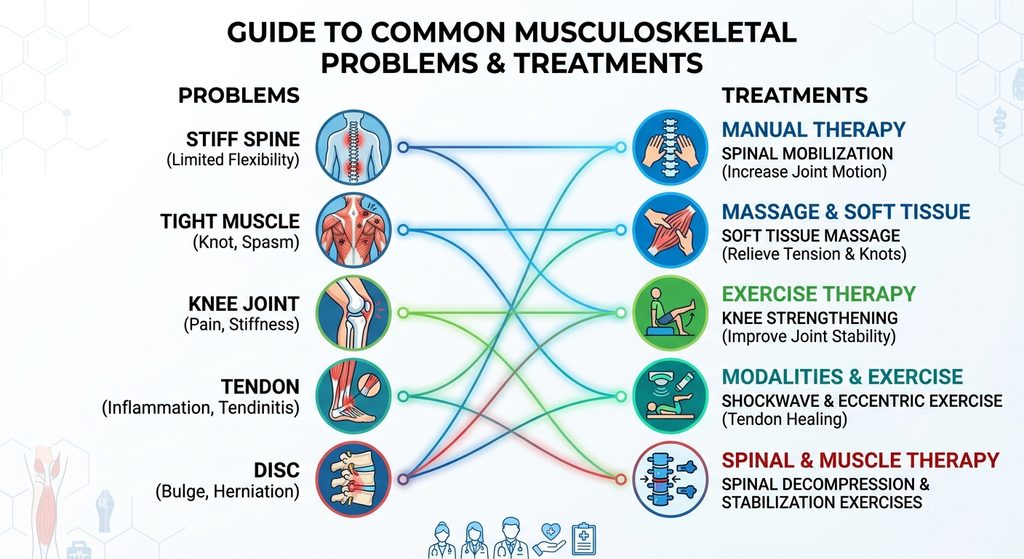
| Problem | Main Treatments |
|---|---|
| Stiff spinal joints | Adjusting, soft tissue work, mobility exercise |
| Muscle tension and trigger points | Massage, dry needling, stretching |
| Hip or knee osteoarthritis | Strengthening exercise with joint mobilisation |
| Tendon pain | Progressive loading, shockwave therapy, taping |
| Disc-related back or neck pain | McKenzie method, adjusting, rehab |
Case Study: Stiff Knees and a Sore Back
This example is a composite of common presentations we treat. Details are illustrative and do not describe a single patient.
The presentation: A 56-year-old teacher has knee stiffness that is worse on the stairs and after sitting, plus lower back stiffness each morning that eases within 20 minutes. Walking at weekends has dropped from an hour to 20 minutes.
The assessment: Activity-related knee pain with short morning stiffness, consistent with knee osteoarthritis. Stiff lower back joints and weak hip muscles. No signs of inflammatory arthritis or red flags.
The plan:
- Weeks 1 to 3: joint mobilisation of the knee and lower back, soft tissue work, and a simple home strengthening routine
- Weeks 3 to 8: progressive strengthening for the hips and thighs, with a graded walking plan
- Weeks 8 to 12: visits spaced out, focusing on long-term independence
The outcome: Pain on the stairs eases and walking time builds back up week by week. The key change is not the knee itself, but the strength and confidence to use it.
Self-Care for Musculoskeletal Pain
- Keep moving within comfortable limits; long rest usually increases stiffness
- Use heat for stiff joints and tight muscles
- Break up sitting every 30 to 45 minutes
- Strengthen twice a week, especially hips, thighs and upper back
- Build activity gradually, rather than in sudden jumps
- Prioritise sleep, which plays a large part in how much pain you feel
Book an Assessment in Clapham
BackSpace is a multi-award-winning chiropractic and sports massage clinic at 15 Clapham Park Road, London SW4 7EE, a one-minute walk from Clapham Common Underground station (Northern line). Meet our GCC-registered chiropractors, browse our frequently asked questions, call 020 7498 7998 or book an appointment online.
Frequently Asked Questions
-
What is musculoskeletal pain?
Musculoskeletal pain is pain that affects the muscles, bones, joints, tendons, ligaments or the nerves supplying them. Common examples include back pain, neck pain, joint stiffness, muscle strains and tendon problems. It can be acute, following an injury or flare-up, or chronic, lasting more than three months. Most musculoskeletal pain is mechanical rather than serious, and it usually responds well to a combination of hands-on treatment, exercise and gradual return to normal activity.
-
What is the difference between arthralgia and arthritis?
Arthralgia means joint pain from any cause, while arthritis means the joint is inflamed or structurally changed. You can have arthralgia without arthritis, for example after overuse or a minor strain. Osteoarthritis typically causes pain with activity and short morning stiffness, while inflammatory arthritis often causes warm, swollen joints and stiffness lasting longer than 30 minutes. Inflammatory symptoms should always be assessed by a GP, who may refer you to a rheumatologist.
-
Can a chiropractor help with joint stiffness?
Yes. Chiropractors assess how your joints move and treat stiffness with joint adjusting, mobilisation, soft tissue work and targeted exercise. This approach suits mechanical stiffness in the spine, hips, knees, shoulders and other joints, including osteoarthritis when combined with strengthening exercise. Stiffness with hot, swollen joints, long morning stiffness or several joints affected at once may point to an inflammatory condition, and your chiropractor will refer you to your GP.
-
Where can I find a joint stiffness chiropractor near me in London?
BackSpace offers chiropractic care for joint stiffness at 15 Clapham Park Road, London SW4 7EE, a one-minute walk from Clapham Common Underground station on the Northern line. Patients come from Clapham, Brixton, Balham, Stockwell and Battersea. Your first visit includes a full assessment by a GCC-registered chiropractor to find the cause of your stiffness, followed by a plan combining hands-on treatment and exercises you can continue at home.
-
When should I see a doctor about musculoskeletal pain?
See a doctor if you have a hot, red or swollen joint, pain with fever or unexplained weight loss, constant bone pain that wakes you at night, or several swollen joints at once. Pain after a significant fall should also be checked. Call 999 if back pain comes with numbness around the genitals, loss of bladder or bowel control, or weakness in both legs, as these can signal serious nerve compression needing emergency care.
Muscles, joints and bones are built to adapt, and with the right guidance, most musculoskeletal pain can be turned around.