
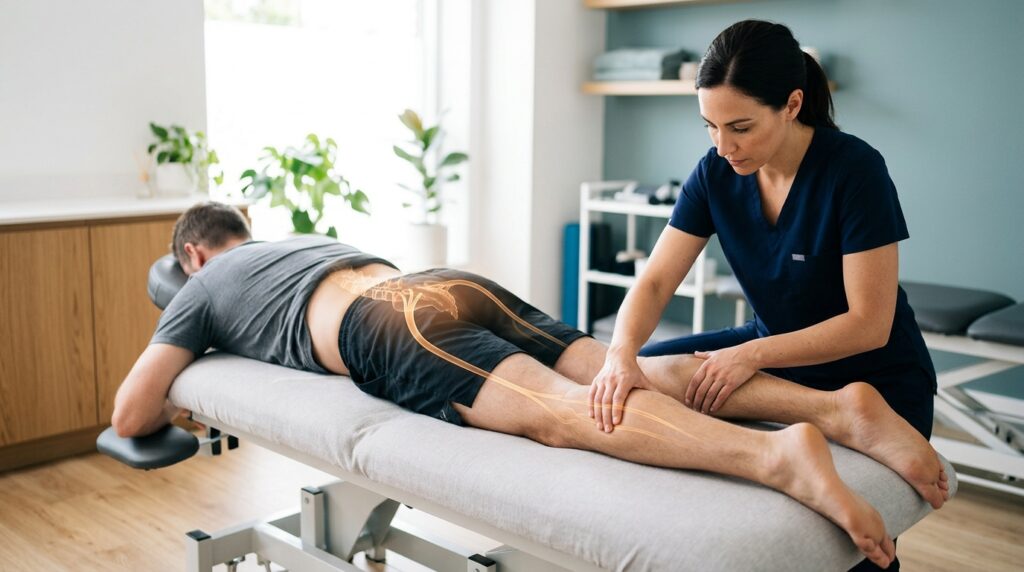
Leg pain is one of the most common reasons people walk through our door, and it rarely has a single, obvious cause. The pain might come from a strained muscle, an irritated tendon, a stiff hip or knee, or the sciatic nerve being squeezed in your lower back, while a small number of cases are linked to blood circulation and need a doctor rather than a chiropractor. As GCC-registered chiropractors helping people who search for a chiropractor near me in Clapham since 2016, our first job is to work out where your leg pain is really coming from. This guide covers the common causes, the warning signs not to ignore and when chiropractic care is the right choice.
Why the Source of Leg Pain Matters
Pain in legs does not always start in the leg. The lower back, pelvis and hip can all send symptoms down the leg, a process called referred pain. That is why rubbing or stretching the sore spot sometimes makes no difference: the problem sits somewhere else.
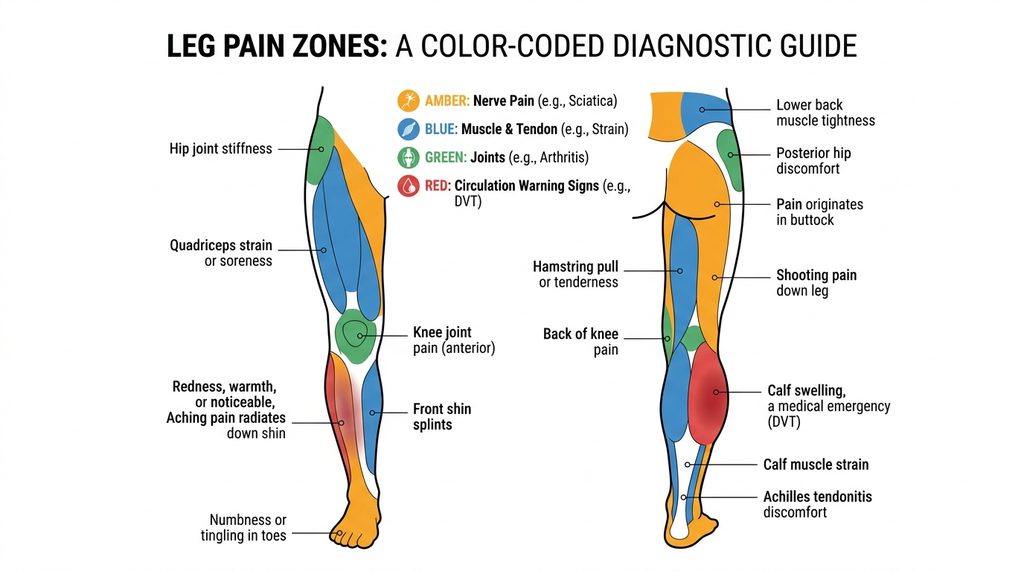
Broadly, leg pain falls into four groups:
- Nerve-related: pain caused by irritation of a nerve, most often the sciatic nerve
- Muscle and tendon: strains, cramps, tendinopathy and overuse injuries
- Joint-related: hip, knee and ankle problems that refer pain into the leg
- Circulation-related: blood clots and narrowed arteries, which need medical assessment
Getting the category right is the difference between treatment that works and weeks of frustration.
Nerve-Related Leg Pain and the Sciatic Nerve
What Is the Sciatic Nerve?
The sciatic nerve is the longest and thickest nerve in the body. It forms from several nerve roots in the lower back, passes through the buttock and runs down the back of the thigh, before splitting to supply the lower leg and foot.
Sciatica
When something presses on or irritates the nerve roots that form the sciatic nerve, the result is sciatica. According to the NHS guidance on sciatica, a slipped disc is the most common cause, followed by spinal stenosis, a slipped vertebra and back injuries. Typical features include:
- Pain in the buttock and back of one leg, sometimes into the foot and toes
- Sharp, burning or shooting pain, often with tingling or numbness
- Leg pain that feels worse than any back pain
- Symptoms that flare with coughing, sneezing or sitting for long periods
Sciatica often sits alongside lower back pain, but the back can be surprisingly quiet. Many patients are amazed that their calf pain is coming from a disc.
Spinal Stenosis
In older adults, narrowing of the spinal canal can cause aching, heavy legs when walking or standing that ease when sitting or bending forward. This is known as neurogenic claudication.
Muscle and Tendon Causes of Leg Pain
Muscle Strains
Hamstring, calf and groin strains are common in runners, footballers and anyone who suddenly increases their activity. They cause sharp pain at the moment of injury, followed by tenderness, swelling and pain with stretching. Recurring strains are often linked to sports injuries that were never fully rehabilitated.
Cramps and Muscle Spasms
Sudden, painful tightening of the calf or thigh, often at night, is usually harmless. Dehydration, fatigue and long periods in one position can all play a part. Frequent or persistent muscle spasms can also be the body’s way of protecting an irritated nerve or joint.
Post-Exercise Soreness
Delayed onset muscle soreness peaks a day or two after unfamiliar exercise and settles by itself. Our guide on how to deal with muscle soreness after exercise explains how to tell it apart from an injury.
Tendinopathy
Achilles, patellar and hamstring tendon problems cause pain that is often worst first thing in the morning or at the start of activity, then eases as you warm up, before returning later. Tendons respond well to progressive loading and, in persistent cases, shockwave therapy.
Joint-Related Leg Pain
Problems in the hip and knee commonly send pain into the thigh, shin or calf:
- Hip joint irritation can cause groin, thigh and even knee pain
- Knee problems such as patellofemoral pain cause aching around the kneecap with stairs and squatting
- Foot problems such as plantar fasciitis change how you walk, overloading the calf and shin
If your symptoms centre on the joints themselves, our page on hip and knee pain covers these in more detail.
Leg Pain Pattern Decoder
The way your leg pain behaves gives important clues. This is a simplified version of the reasoning we use in clinic.
| Pattern | Likely Category | What It Suggests |
|---|---|---|
| Shooting pain down the back of the leg, with tingling | Nerve | Sciatic nerve irritation |
| Heavy legs walking, eased by sitting or bending forward | Nerve | Spinal stenosis |
| Calf ache walking, eased by standing still | Circulation | Possible peripheral arterial disease, see GP |
| One swollen, warm, throbbing calf | Circulation | Possible blood clot, get urgent help |
| Sharp pain at a moment of effort, then tenderness | Muscle | Strain |
| Stiff at the start of activity, eases, returns later | Tendon | Tendinopathy |
| Pain on stairs, squatting or getting up from a chair | Joint | Hip or knee problem |
Warning Signs: When Leg Pain Needs a Doctor
Some causes of leg pain are medical emergencies and need care from a doctor, not a chiropractor.
Call 999 or go to A&E if you have:
- Sciatica in both legs, or weakness or numbness in both legs
- Numbness around your genitals or bottom
- Loss of bladder or bowel control, or difficulty passing urine
- A swollen, painful leg with shortness of breath or chest pain
- A suddenly cold, pale and very painful leg
Call 111 or see your GP urgently if you have:
- Throbbing pain and swelling in one calf or thigh, with red or darkened skin. The NHS lists these as signs of a DVT, especially after surgery, a long journey or a period of reduced movement.
- Calf or thigh pain that comes on with walking and eases within minutes of rest. This can be a sign of peripheral arterial disease, particularly if you smoke or have diabetes.
- Leg pain with fever, unexplained weight loss or a history of cancer
At BackSpace, every patient is screened for these signs during their first assessment, and we refer to your GP whenever a non-mechanical cause is suspected.
When to See a Chiropractor for Leg Pain
Chiropractic care is a good fit when your leg pain is mechanical, meaning it comes from the spine, nerves, muscles, tendons or joints. Book an assessment if:
- Pain travels from your lower back or buttock into your leg
- You have tingling or numbness that changes with sitting, bending or walking
- A muscle strain keeps coming back
- Hip or knee pain is changing how you walk
- Tendon pain has lasted more than a few weeks
- Pain has not improved with rest and simple self-care
Leg Pain Treatment in London: How We Help
Our approach to leg pain treatment starts with finding the source, then combining hands-on care with exercise. This reflects NICE guidance on low back pain and sciatica, which recommends considering manual therapy only as part of a package that includes exercise.
Chiropractic Care
- Joint adjusting to restore movement in the lower back, pelvis, hip, knee and ankle
- Soft tissue work to release tight muscles around the hip and thigh
- Dry needling for trigger points in the glutes, hamstrings and calves
- Muscle taping to support the knee, calf or foot during recovery
McKenzie Method and Rehab Exercises
For disc-related sciatica, the McKenzie method helps identify movements that draw leg pain back towards the spine. We then build a strengthening programme for the hips, core and legs, delivered through our free app.
Sports and Deep Tissue Massage
Sports and deep tissue massage eases tight hamstrings, calves and deep hip muscles, which often guard an irritated nerve or overloaded tendon.
Shockwave Therapy
Shockwave therapy is used for persistent tendon problems such as Achilles, patellar and hamstring tendinopathy, along with hip and groin pain. It is not a treatment for nerve pain.
| Cause | Main Treatments at BackSpace |
|---|---|
| Sciatica | Adjusting, McKenzie method, soft tissue work, rehab |
| Muscle strain | Massage, dry needling, graded loading |
| Tendinopathy | Progressive loading, shockwave therapy, taping |
| Hip or knee pain | Joint adjusting, strengthening, taping |
| Circulation problems | Referral to GP |
Case Study: The Hamstring Strain That Wasn’t
This example is a composite of common presentations we treat. Details are illustrative and do not describe a single patient.
The presentation: A 34-year-old five-a-side player has had recurring “hamstring strains” for six months. Each time, the pain settles with rest, then returns within weeks of playing again.
The assessment: The hamstring itself is strong and not tender. Leg pain is reproduced by a seated nerve tension test and by repeated bending of the lower back. The pattern points to irritation of the sciatic nerve rather than a muscle tear.
The plan:
- Weeks 1 to 2: lower back and pelvic adjusting, soft tissue work to the glutes and McKenzie extension exercises
- Weeks 3 to 6: nerve mobility exercises, hip and core strengthening
- Weeks 6 to 8: return-to-sprint programme and running drills
The outcome: With the true source treated, the “hamstring” pain stops recurring. This is a pattern we see often: when a strain keeps coming back, the back of the leg is not always the problem.
Preventing Leg Pain
- Increase training load gradually rather than in sudden jumps
- Break up long periods of sitting every 30 to 45 minutes
- Strengthen your glutes, hamstrings and calves twice a week
- Stay hydrated, particularly in warm weather and after exercise
- Move regularly on long journeys to protect your circulation
- Get recurring or spreading pain assessed early
Book a Leg Pain Assessment in Clapham
BackSpace is a multi-award-winning chiropractic and sports massage clinic at 15 Clapham Park Road, London SW4 7EE, a one-minute walk from Clapham Common Underground station (Northern line). You can meet our GCC-registered chiropractors, call 020 7498 7998 or book an appointment online.
Frequently Asked Questions
-
What is the most common cause of leg pain?
Muscle strains, cramps and overuse injuries are the most common causes of leg pain, especially in active people. Sciatica, where the sciatic nerve is irritated in the lower back, is the most common nerve-related cause and often produces pain down the back of one leg. Less commonly, leg pain is linked to circulation, such as a blood clot or narrowed arteries, which needs prompt medical assessment rather than manual treatment.
-
How do I know if my leg pain is from my back?
Leg pain is likely coming from your back if it travels from the buttock down the leg, comes with tingling or numbness, or changes when you sit, bend or cough. Pain that feels worse below the knee than in the back itself is a typical sign of an irritated nerve root. A chiropractor can confirm this with nerve tension tests and a check of your strength, reflexes and skin sensation.
-
Can a chiropractor help with leg pain?
Yes, when the cause is mechanical. Chiropractors treat leg pain from sciatica, joint stiffness in the back, hip or knee, muscle strains and tendon problems, using joint adjusting, soft tissue work, dry needling and targeted exercise. Leg pain linked to circulation, such as a suspected blood clot or peripheral arterial disease, needs a doctor. A thorough first assessment identifies which type of leg pain you have before any treatment begins.
-
Where can I get leg pain treatment in London?
BackSpace offers leg pain treatment in London from its clinic at 15 Clapham Park Road, SW4 7EE, a one-minute walk from Clapham Common Underground station on the Northern line. Patients come from Clapham, Brixton, Balham, Stockwell and Battersea. Every first visit includes a full assessment by a GCC-registered chiropractor to find the source of the pain, followed by a treatment plan combining hands-on care and home exercises.
-
When is leg pain an emergency?
Leg pain is an emergency if it comes with numbness around the genitals or bottom, loss of bladder or bowel control, or weakness in both legs, as these can signal serious nerve compression. A swollen, painful leg with shortness of breath or chest pain may mean a blood clot has reached the lungs. A suddenly cold, pale and very painful leg also needs immediate help. Call 999 in any of these situations.
Leg pain is the end of the story, not the start of it, and finding where it truly begins is what makes treatment work.